Showing 11
Forks for every ride

Built around how you actually ride.

Understand how different forks are use for different riders.

Gravel and bikepacking riders make up most of Auren’s titanium customers, and the fork carries more of that ride than most people expect. Titanium’s flex under load smooths out corrugations, rocks and rutted fire trails before they reach your hands, which matters over an eight-hour day on rough surfaces. Because every fork is built or matched to your frame’s exact geometry, axle-to-crown, offset and trail stay dialled in rather than approximated by a generic size chart. Modern titanium forks use a truss-style brace between the legs, solving the flex problem that limited older single-blade designs. That stiffness pays off when the fork is also carrying weight: mounts for a front rack, cargo cage or fork bag are welded in rather than riveted on, so they hold up over a multi-day loaded trip. Riders doing week-long camping routes or a Saturday loop out past Emerald want the same thing from a fork, comfort that doesn’t cost them cargo capacity or handling. Titanium doesn’t corrode, so a fork that’s been rained on, mud-caked and hosed down for a decade still rides the way it did on day one. For riders chasing the lightest possible setup and happy to trade some of that durability for it, a carbon gravel fork is the alternative, and Auren carries both.

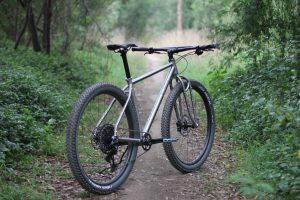
Hardtail adventure riders want a fork that can take a real hit and keep going, and that’s where titanium’s durability matters more than its weight. A titanium truss fork bridges the two legs with a brace, which stiffens the whole structure against the twisting loads that technical singletrack puts through a fork blade. That extra stiffness doesn’t come at the cost of comfort: titanium still absorbs trail chatter the way carbon and aluminium can’t, so descents feel calmer even as the terrain gets rougher. For riders heading out on the train to ride proper trails rather than commute on tame fire roads, geometry matters as much as material, and a custom build sets axle-to-crown and head angle to suit your frame and your riding rather than a generic size run. A rigid mountain fork still needs to survive rock strikes and drops without the microfractures that can end a carbon fork’s life; titanium doesn’t develop those fractures the same way. A dent shows. A crack generally doesn’t. That’s the trade every hardtail rider is quietly making when they choose material: carbon for outright weight, titanium for a fork that shrugs off the terrain and rides the same in year ten as it did on day one. Riders building a fully rigid setup for bikepacking-style mountain routes get the same truss construction, with clearance and geometry tuned for that use instead.

Road riding asks a different question of a fork: how light and stiff can it be without giving up precision through a fast corner. That’s a carbon fork’s strength, and it’s why most Auren road builds run a carbon fork even when the frame itself is titanium. A shorter axle-to-crown drops the front end and sharpens handling, and reduced offset increases trail for the calmer, more confident steering that beach-road and bunch riders want at speed. Hidden cable routing keeps the front end clean on a build where every line matters, which is why Auren’s road fork is routed internally rather than externally like a touring or gravel setup. Weight matters more here than on any other ride style; every gram at the front of the bike is one a rider notices on a climb or a sprint out of the bunch. Road riders are also the group most likely to treat their bike as a dedicated machine rather than an everyday ride, so the fork gets specced for performance first and comfort second. It still needs to survive serious mileage, club rides and early starts week after week, which is where fit and build quality do the work raw material can’t. A fork matched precisely to the frame’s geometry, rather than picked from a generic size run, is what keeps that handling sharp as the kilometres add up.

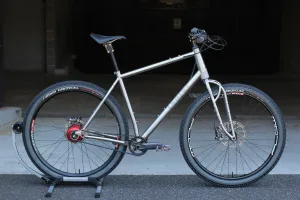
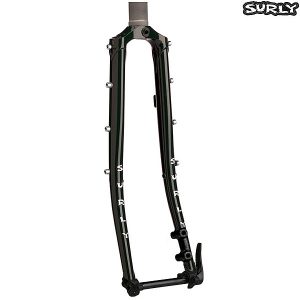
Loaded touring and bikepacking put more strain through a fork than any other ride style, and it’s the category where the truss-style titanium build earns its keep. Multiple welded mounts, on the crown, the legs and sometimes a mid-fork cage point, let a rider carry a genuine touring load without relying on a rack clamped to the outside of the tube. Welded mounts hold up to that load in a way riveted ones don’t, and titanium’s natural give means the fork absorbs the corrugations of a loaded, multi-day route rather than transmitting every one of them into the rider’s hands. Around two-thirds of Auren’s gravel and touring customers ride fully loaded, multi-day trips with everything they need on the bike, and the fork is one of the first things specced on a build like that, before the rest of the geometry is finalised. A generous axle-to-crown and stable, unhurried steering geometry matter more here than outright agility; a twitchy fork is exhausting to control on hour six of a loaded day. Titanium doesn’t corrode, which matters for a fork that’s going to see rain, river crossings, salt air and months of storage between trips over a bike’s lifetime. That’s also why it’s the material most touring riders settle on once they’ve priced up the alternative: a rigid fork built once, for the load it needs to carry, rather than upgraded every few seasons. Auren builds two versions for this exact use, one tuned for structured touring routes and one for looser bikepacking setups with more tyre clearance.

Customisation Options

Design your fork for you

Material is the first decision on any fork, because it decides what you’re trading off before geometry or mounts come into it. Titanium is the default for anyone building a custom bike that needs to last: it flexes just enough to take the edge off rough surfaces, it doesn’t corrode, and a well-built titanium fork built today is still riding fine in twenty years. Auren welds titanium forks in a truss-style construction, bracing the two legs together, which is what solves the flex and precision problems that limited older single-blade titanium designs. Carbon is the lighter option, and engineers can tune exactly how much compliance goes into the layup, which is why it’s still the default for road builds where every gram counts. The trade-off is durability: carbon handles fatigue well, but a hard impact, a rock strike or a crash, can crack it in a way that isn’t always visible, so it rewards careful riding more than titanium does. Steel sits at the other end, beautifully compliant and endlessly repairable anywhere in the world with a welder, but heavier and prone to rust if the finish is neglected. Auren doesn’t currently build steel or stainless forks as a standard option, but the same custom process applies to any material a build calls for; talk to Will if that’s what your frame needs. Most Auren builds end up pairing a titanium frame with a titanium fork for gravel, touring and mountain use, and a titanium frame with a carbon fork for road, because that’s where each material actually performs best, not because of style.

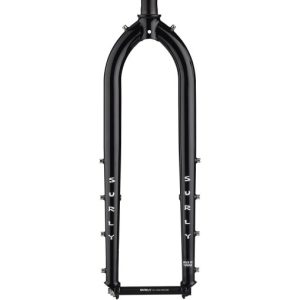
The truss-style build is what makes a modern titanium fork work. Older single-blade titanium forks flexed unpredictably under load, which is part of why they fell out of favour even as titanium frames stayed popular; bracing the two legs together with a truss solves that, giving the fork torsional stiffness without losing the material’s natural compliance. Crowns and dropouts are 3D printed or cast rather than simply welded from tube stock, which lets the fork put material exactly where it needs strength, at the steerer junction and the axle, without adding weight everywhere else. Mount count and placement are the other half of the decision, and they matter more on a fork than most riders expect: a rack mount, a cargo cage boss, a mid-fork bag mount, each one needs to be welded in rather than riveted on if it’s going to hold a real load over a multi-day trip. Welded mounts share the fork’s own strength; riveted ones are a weak point waiting to loosen or shear. That’s the difference between a fork that can genuinely carry a loaded pannier or cargo cage for months on end, and one that only looks like it can. Steerer standard and length are set to match your frame and headset exactly, along with axle type and brake mount, so nothing about the fit is a compromise made because a generic size happened to be close enough. Every one of these choices, truss design, mount placement, steerer length, gets set at the same time as your frame’s geometry, not tacked on afterwards as an accessory decision.

A titanium fork leaves the shop with a brushed satin finish, the raw metal itself rather than a paint job sitting on top of it. That’s not a style choice so much as titanium not needing one: it doesn’t rust, doesn’t need a protective coating, and a scratch just polishes back out rather than exposing bare metal underneath. Most riders leave it as-is, since it’s the finish that ages best and matches a titanium frame built the same way. {confirm with Will} on whether a satin/brushed-vs-polished choice or any anodised highlight is offered as a standard option versus a custom request. Carbon forks are supplied in their standard factory finish, matte or gloss depending on the model, since a carbon layup isn’t something Auren refinishes locally.

The wider picture

Understanding the custom fork market

Most forks sold in Australia come from two places: mass-produced units picked off a shelf by size and steerer standard, or fully bespoke builds from small local frame builders who treat a fork as part of a much longer, much more expensive commission. Neither is really built to match an existing frame’s exact geometry unless you’re paying boutique prices for the privilege. Auren sits between the two, forks built or matched to your frame’s specific geometry, in titanium or carbon, at a price close to what a good off-the-shelf fork already costs. The gap isn’t a quality trade-off, it’s a different supply chain: Auren sources from a vetted titanium manufacturer and handles the fit and construction spec locally, rather than running a full in-house frame shop for every commission.

Mass-market option
A generic carbon or aluminium fork, sized by steerer and axle standard, sold off the shelf with no reference to your frame's actual geometry.
Boutique custom builders
Small local frame builders who'll cut a fork to match, usually as part of a full bespoke commission running months and several times the price.
Auren
A fork built or matched to your frame's exact geometry, in titanium or carbon, at close to off-the-shelf pricing.
FAQ

Forks, answered.

What's the difference between a titanium and a carbon fork?

Titanium flexes naturally and doesn’t corrode, so it suits gravel, touring and mountain riding where comfort and durability matter over a long day. Carbon is lighter and stiffer, which is why it’s still the better choice for most road builds.

Do titanium forks flex too much for aggressive riding?

No. Modern titanium forks use a truss-style build that braces the two legs together, which solves the flex and precision problems older single-blade titanium designs had. The compliance you feel is in the ride quality, not in unpredictable handling.

Can I get a fork built to match my existing frame?

Yes. Every fork can be built or matched to your frame’s exact geometry, axle-to-crown, offset, steerer and axle standard, rather than picked from a generic size run.

What titanium grade do you use?

Auren’s titanium forks and frames are built from Grade 9 (GR9) titanium.

Will a titanium fork corrode or rust?

No. Titanium doesn’t corrode, so a fork that’s been rained on and ridden through mud for years still holds up the same as it did on day one.

How much does a custom fork cost?

Rigid fork prices generally run from around $340 to $1,350 depending on material and mounts. Suspension forks are priced separately, starting from around $990. {confirm with Will} for an exact quote against your frame and ride style.

Are your forks rigid or suspension?

Auren stocks both. Titanium and carbon builds are almost always rigid, since that’s where those materials perform best; suspension forks are available for hardtail and mountain builds that need one.

Do you build suspension forks?

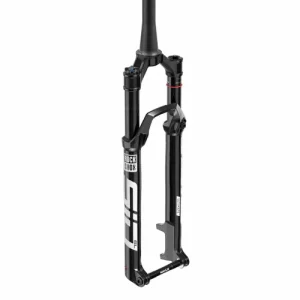
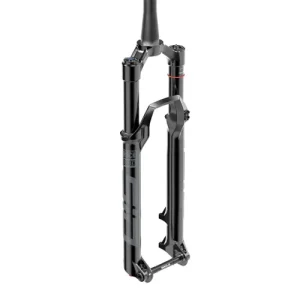
Auren fits proven suspension forks, like RockShox SID models, rather than building them in-house. Titanium and carbon forks are the ones built or matched to your specific frame.

What's axle-to-crown, and why does it matter?

It’s the length of the fork from the centre of the front axle to the crown at the top. It sets your bike’s head angle and ride height, and it’s one of the first measurements matched to your frame during a custom build.

What's fork offset (rake)?

Offset, or rake, is how far the front axle sits forward of the steering axis. It works together with head angle to set trail, which is what actually determines how the bike steers.

What's trail, and how does it affect handling?

Trail is the result of head angle and offset combined. More trail generally means calmer, more stable steering; less trail means quicker, more responsive handling, and it’s set to suit the ride style the fork’s being built for.

How many mounts can a titanium fork have?

Mount count depends on the build. Touring and bikepacking forks typically carry the most, crown mounts, leg mounts and sometimes a mid-fork cage mount, welded in rather than riveted so they hold a real load.

Are the cargo mounts strong enough for bikepacking?

Yes, when they’re welded in. Auren’s titanium forks weld mounts directly into the structure rather than riveting bosses on afterwards, which is what lets them carry a genuinely loaded pannier or cargo cage over a multi-day trip.

What steerer standard do you use?

Steerer standard and length are matched to your frame and headset during the build. Tapered steerers are now standard on modern frames, and that’s what most Auren forks are built around.

Will the fork fit my current headset and brakes?

It can be, as long as the fork is built to your frame’s steerer standard, brake mount and axle type. Confirm your frame’s specs when you enquire and the fork gets built to match.

How long does a titanium fork last?

A well-built titanium fork, ridden and stored reasonably, lasts decades rather than years. Titanium doesn’t fatigue or corrode the way aluminium and untreated steel can.

How do I know which ride style fork is right for me?

Start with how you actually ride: long mixed-surface days point to gravel, loaded multi-day trips point to touring or bikepacking, technical trails point to mountain, and pure road riding usually points to carbon rather than titanium. Will can help you land on the right build during the enquiry conversation.

Can I buy just a fork, or does it have to be part of a full build?

Forks can be bought on their own or as part of a full custom build. Bought on its own, it still gets built or matched to your frame’s geometry, it just skips the rest of the bike.

How long does a custom fork take to build?

{confirm with Will} for current lead times on a standalone fork order. A full custom titanium build generally runs four to five months.

Do carbon forks crack, and how would I know?

Carbon forks handle fatigue well, but a hard impact, a rock strike or a crash, can crack the material in a way that isn’t always visible from the outside. If a carbon fork’s been in a solid impact, it’s worth having it checked before you keep riding it.

Explore your rides

Custom builds for every ride.

Frame or full bike, every build starts the same way: designed around you. If you're weighing up where you ride most, start here.

Everything in one place

Before you build.

From spec decisions to the fine print, everything you need before locking in your frame.

Book a call with Will

Ready to talk about your
dream custom bike?

Book consultation
0