Showing 3

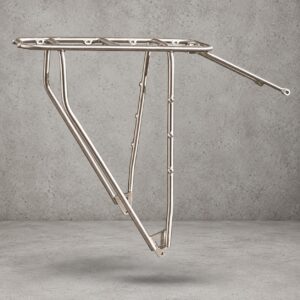
Welded titanium pannier racks built or matched to your frame's mounts, for loaded touring, bikepacking and gravel.
Even riders who aren’t doing full touring loads often want a rack for a day-loop with a saddle bag or a coffee-run pannier, and a welded titanium rack handles that light, occasional load without the wobble a clamp-on rack develops over corrugated fire trails. It’s not carrying camping gear every ride, but it’s there and solid when it needs to be.
Racks are less common on technical singletrack builds, where a frame bag usually makes more sense than anything mounted externally, but hardtail riders doing rougher bikepacking routes still spec a rack for genuine load capacity a seat pack can’t match. The welded construction matters more here than anywhere else, since a rack on a mountain bike takes real impacts, not just vibration.
This is the rack’s core use case. A loaded multi-day trip needs mounts that won’t loosen under the constant flex of a full pannier set, which is exactly what welded titanium construction is built for over a riveted or bolted-on alternative. Around two-thirds of Auren’s gravel and touring customers ride fully loaded multi-day trips, and the rack is one of the parts that decides whether that setup holds up for the whole route or starts working loose by day three.
Most racks sold in Australia are generic aluminium units, clamped onto whatever mounts happen to be on the frame, sized to fit “most” bikes rather than yours specifically. A small number of boutique builders will weld a rack to match a custom frame, usually as part of a much larger commission. Auren sits between the two: a titanium rack built to your frame’s exact mounts and axle standard, at a price close to a decent aftermarket rack rather than a bespoke one.
Yes, when it’s built or matched as part of your Auren frame. If you’re adding one to an existing frame, its mounts and axle standard need to be confirmed first.
{confirm with Will} for exact load ratings, which vary by mount configuration and frame compatibility.
Titanium doesn’t corrode and doesn’t fatigue at weld points the way aluminium can under years of loaded riding, which matters most on a part that’s carrying real weight over rough ground.
{confirm with Will} — it depends on whether your existing frame has compatible rack mounts.
It depends on your load and route. Rear racks handle most day and weekend loads; multi-day, fully loaded touring often adds a front rack to balance the weight.
Titanium racks run $440 to $650 depending on spec and mount configuration. {confirm with Will} for an exact price against your frame.
Yes, a rack can be added to an existing Auren frame or ordered alongside a new build.
No, titanium doesn’t corrode, which is the main reason it’s used for a part that’s rained on, muddied and salted for years.
Yes. Welding removes the flex point that causes most clamp-on racks to loosen or fail under sustained load.
{confirm with Will}, since it depends on whether the frame has any suitable mounting points to weld or bolt to.
Not necessarily. Even a light, occasional load, a saddle bag or a coffee-run pannier, benefits from a rack’s stability over a clamp-on alternative, though it earns its keep most on loaded multi-day trips.
A rack carries genuine load capacity a soft bag can’t match, useful for camping gear or heavier loads. A frame or saddle bag suits a lighter, more streamlined setup instead.
Frame or full bike, every build starts the same way: designed around you. If you're weighing up where you ride most, start here.
From spec decisions to the fine print, everything you need before locking in your frame.