Understanding commuter eBikes
All eBike guides

The commuter eBike guide

Everything you need to know before buying a commuter eBike.

Cycling to work pays off fast: calories burnt, time saved in traffic, and money that would otherwise go to fuel, parking and fares. A typical return commute burns 200–250 calories and can be faster than driving in peak hour. But working out what to look for, and making sense of the commuter eBike market, gets confusing quickly.

This guide breaks down what actually matters when you’re buying a commuter eBike: cost, accessories, power, range, longevity and maintenance, belt drive versus chain, and automatic versus manual gearing. It also covers the health benefits, the law, the common problems and how to avoid them, how to find the right bike, and a review of what’s available on the Australian market.

01

What is a commuter eBike

Built for the trip, not the weekend.

A commuter eBike is built for one job: getting you to work and back, every day, for some, in any weather. That’s what separates it from a road bike, a mountain bike, or a weekend cruiser — each built for something else.

The difference is in the details. An upright, visible riding position rather than hunched for speed. Wider tyres, usually around 700×38–45C, for a stable ride over tram tracks and potholes with grip in the wet. Frame mounts for mudguards, a rack and integrated lights. And robust enough to be left outside, rained on, and ridden again the next morning.

02

Cost — what you pay, and what it's worth

What it costs, and what it saves.

Commuter eBikes in Australia break roughly into tiers.

Under $2,500 Entry-level: cadence sensing motors, chain drive, basic components, little integration.
$2,500–$5,000 The mid-range, where build quality and integration improve meaningfully.
$5,000+ Premium European brands start around here and run past $9,000.

The smarter way to think about price is total cost of ownership, not the sticker. A cheaper bike with a chain, exposed gears and bolt-on parts costs more over five years in maintenance, replacement parts and your own time. A well-built bike costs more upfront and less to live with.

It’s also worth comparing against what you spend now. Parking, fuel, registration and fares add up fast. For many commuters, a $3,000–$4,000 eBike pays for itself within a year or two of replacing the car for the daily trip.

03

Accessories — what makes it commute-ready

Three things that make commuting easier.

Three accessories do most of the work of turning a bike into a daily commuter: lights, mudguards and a rack. Some bikes come with these built in from the factory; on others you add them yourself afterwards. Both work — it's worth knowing which you're getting.

Lights.

Keep you visible and let you ride after dark. Integrated lights run off the main battery, so there's nothing separate to charge. Clip-on lights do the same job but can be left at home or run flat.

Mudguards.

Keep road spray off your back and your bag in the wet. Factory-fitted alloy guards are sturdier than aftermarket plastic, though a good aftermarket set works fine.

Racks.

Carry a bag, panniers or groceries so you're not riding with a loaded backpack. A rack made for the frame sits more securely than a generic bolt-on.

What to look for: whether these come included or need buying separately — it changes both the price and how well they fit.

Integrated rear light
Front rack
04

Power — motor type and torque

How it climbs, and how it pulls away.

The motor is where the difference between a cheap and a well-made eBike is easiest to feel. A cheaper motor delivers power less smoothly, is often noisier, and has less torque, which shows up most on hills and pulling away from a stop. A better motor feels quieter and more natural, assisting you rather than surging or lagging.

You can’t feel any of that from a spec sheet, so here’s what to read instead.

Torque (Nm).

The most useful number — it's the motor's pulling power. For a commuter, 50–80 Nm handles hills and loaded starts comfortably. Below 40 Nm is budget territory, fine on flat ground and noticeable on any gradient. Worth noting: manufacturers measure Nm differently, so two bikes with the same spec on paper can feel quite different in practice. Two forms of due diligence — look for customer mentions of power or hill performance in reviews, and if possible, test ride on an actual hill before committing.

Motor position.

Mid-drive motors (at the pedals) have traditionally been the better choice for commuting, balancing weight better and climbing more efficiently than hub motors (in the wheel). Hub motors are cheaper and more common at the budget end. That said, newer sensor technology is allowing some hub-drive motors to close that gap significantly, delivering a smoother, more responsive feel that was previously only associated with mid-drive. Worth looking into before ruling a hub-drive bike out on motor position alone.

Named brand.

Bosch, Shimano, Bafang or Ananda mean a tested, documented motor with parts and support behind it. An unnamed motor is the equivalent of an unbranded battery cell.

05

Range — how far, realistically

More range isn't always more bike.

More range sounds better, but it comes at a cost. Bigger batteries are heavier and more expensive, and most commuters never use the range they pay for.

The honest question is how far you actually ride. A typical Australian commute is 5–15 km each way. A bike with 60–80 km of real-world range covers that for most of a working week on one charge. Advertised range is almost always higher than real-world, because makers test in ideal conditions: take 20–30% off the headline figure for a realistic number. Hills, rider weight, headwind, cold and assist level all pull it down.

What matters more than the headline number is cell quality, which is covered in the safety section below.

What to look for: at least 60 km of real-world range, which usually means 80–100 km advertised. More than that is a bonus, not a necessity for most commuters.

06

Longevity — the cost that shows up later

The bike you're still riding in two years.

Maintenance is the cost most buyers underestimate. A commuter eBike that needs constant attention quietly becomes a bike you stop riding.

The maintenance-heavy parts on a typical eBike are the chain (oiling, replacement every 12–18 months), gear cables (they stretch and need adjusting), derailleurs (vulnerable to knocks and motor torque), and bolt-on accessories (they loosen over time).

The lowest-maintenance setup removes as many of those as possible: a belt instead of a chain, sealed or internal gearing instead of an exposed derailleur, hydraulic disc brakes that self-adjust as the pads wear, and integrated wiring that isn’t exposed to the weather. A bike built this way runs on roughly one service a year for most riders.

What to look for: sealed, low-maintenance components and a frame warranty of at least 2 years. A brand willing to back the build for years expects it to last.

07

Drivetrain — belt vs chain

The part you'll maintain most, or never think about.

Most eBikes use a chain and derailleur. It's cheap to make and widely understood, but for a daily rider it's also the part that demands the most attention.

Chain

Cheap, common, demanding.

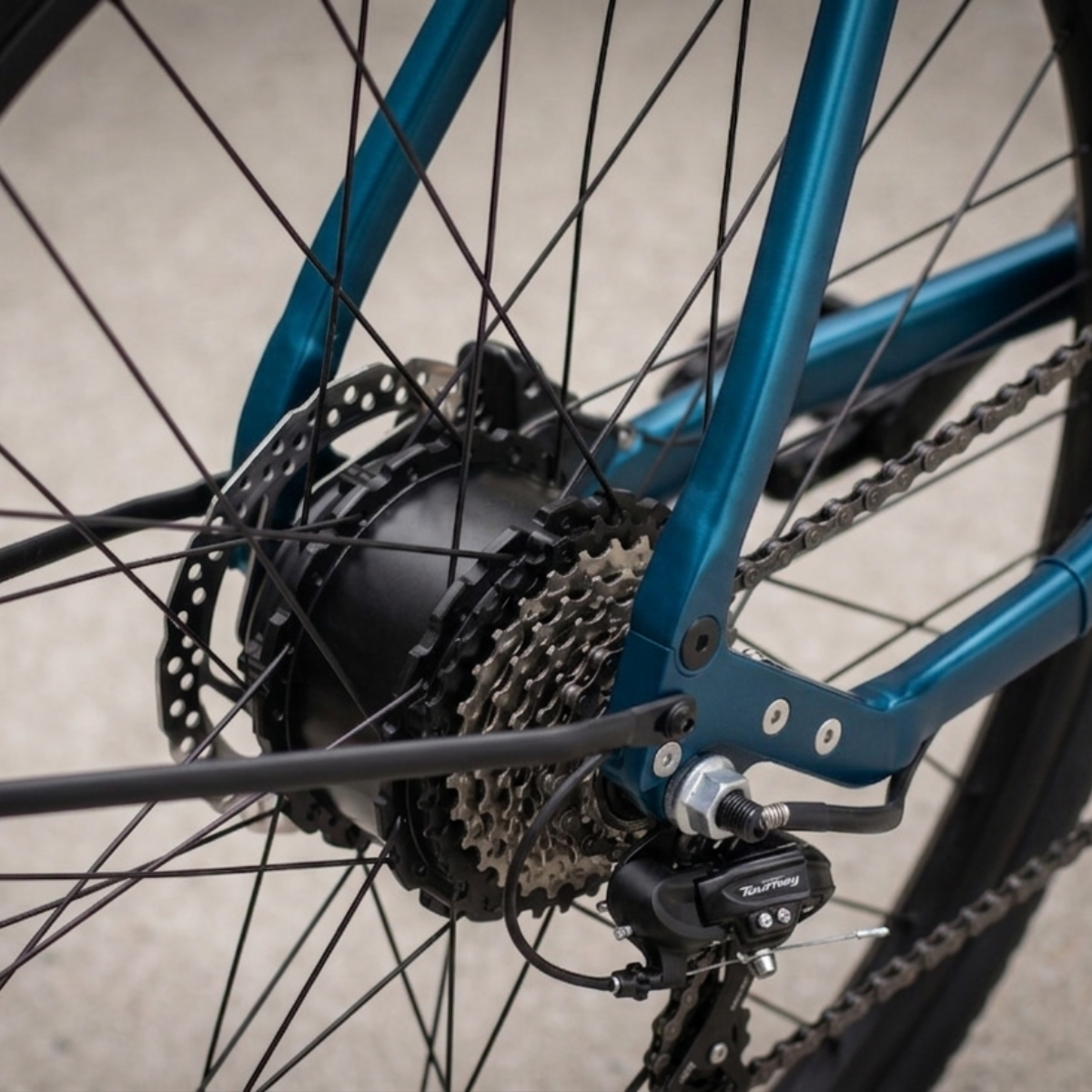
A chain and derailleur is cheap to make and widely understood. For a daily rider it's the part that demands the most attention: regular oiling, adjustment, and replacement before it wears through the parts around it.

Carbon belt

Silent, sealed, 30,000 km+.

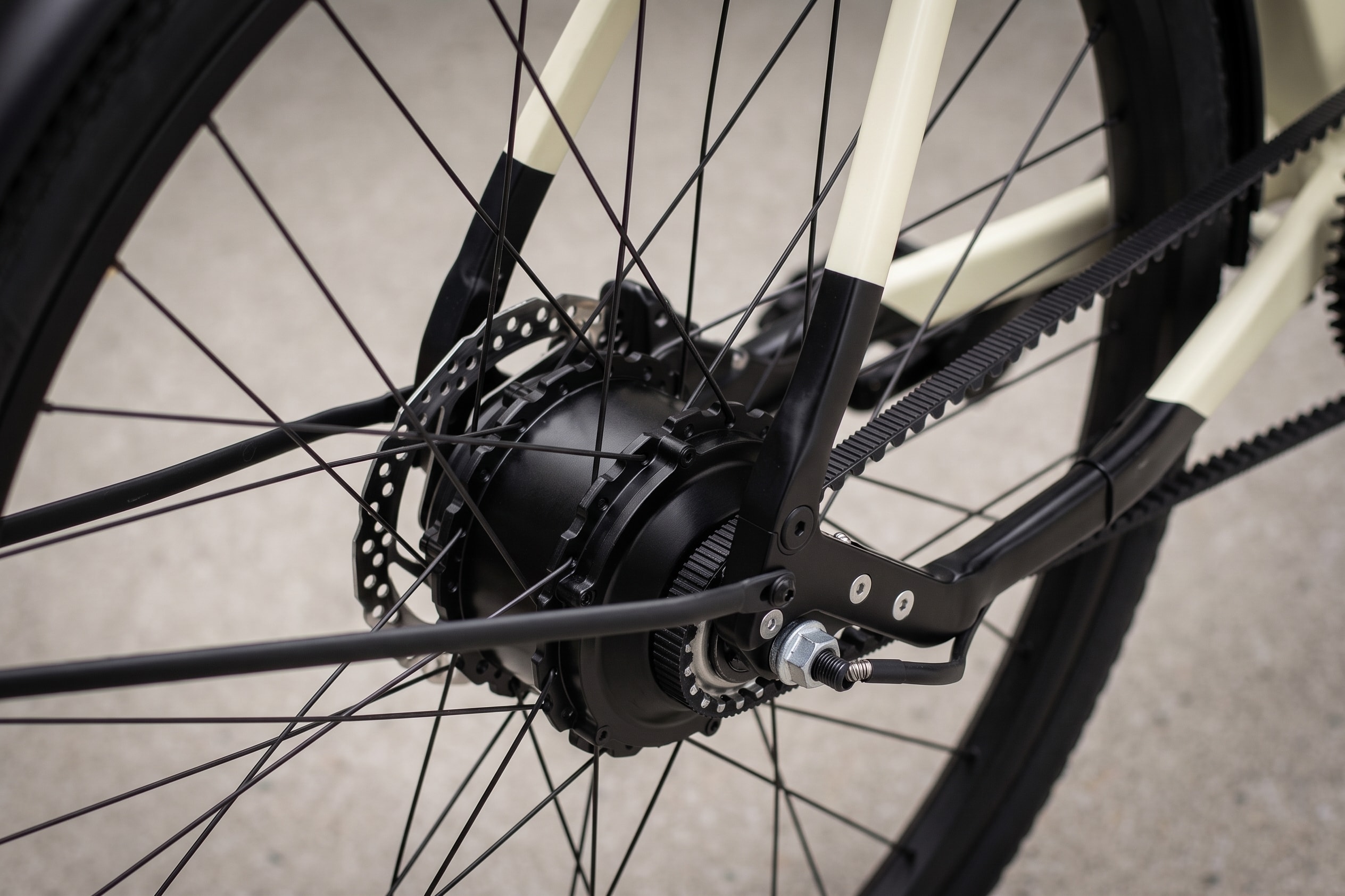
A carbon belt drive replaces the chain entirely. It runs dry and clean, doesn't stretch or rust, needs no oil, and is rated past 30,000 km, several times the life of a chain. The trade-off is that a belt needs a frame designed for it, so it can't be retrofitted to just any bike.

Belt drive is still more common on mid-range and premium bikes than cheap ones, but it’s becoming more accessible, and some well-priced direct-to-consumer bikes now offer it. If you can find it in budget, it’s worth prioritising for a daily commute.

What to look for: the spec will say “belt drive” or “chain drive.” If it says neither, assume a chain.

Belt drive
Chain drive
Want to explore this further? Check out this Auren guide. Belt Drive eBike Guide
08

Gearing — automatic vs manual

The last thing about cycling with a learning curve.

Most eBikes use manual gears: you shift through them yourself with a lever, the same as a regular bike.

Automatic gearing changes that. The bike selects the right gear for your speed and the gradient, continuously, without any input from you. No shifter, no learning curve, no being caught in the wrong gear at a red light. For stop-start city commuting, with its constant lights, junctions and hills, this is exactly where it earns its keep. You pull away in the right gear every time.

If you already enjoy shifting, manual is familiar and fine. If you’d rather just ride and let the bike handle it, automatic removes the last part of cycling that takes any learning. It’s a genuine difference in experience, not just a convenience.

What to look for: automatic gearing is rare and usually achieved through an internal hub or an integrated gearbox-motor unit. If a bike offers it at an accessible price, that’s unusual and worth noting.

Want to explore this further? Check out this Auren guide. What is an Automatic eBike
10

Common problems & how to avoid them

The problems worth knowing, and the fixes.

Safety in traffic.

The biggest concern for new commuters is riding among cars. The practical fix is route planning. Most cities have quiet streets, bike paths and river or park routes that avoid the worst traffic entirely. A few minutes mapping your commute once makes every ride afterwards easier. Don't think about your bike route the same way you used to drive.

Constant maintenance.

Cheap, high-maintenance bikes get abandoned. The fix is choosing a low-maintenance design from the start: belt drive, sealed gearing, hydraulic brakes and integrated wiring, as covered above. The less the bike asks of you, the more you'll ride it.

Trusting an unknown brand (EN15194).

EN15194 is the European safety standard for eBikes, used as the benchmark in Australia. It covers the motor, battery, braking and electrical systems together. A bike certified to it has been tested against a recognised standard rather than just assembled to a price. It's the single clearest signal that a bike is built and wired properly.

Battery safety.

Nearly every eBike fire reported in Australia has involved cheap, unbranded cells with no battery management system (BMS), the electronics that monitor temperature, voltage and charge to prevent the conditions that cause fires. A battery built from cells by a known maker (Samsung, Panasonic, LG) with an integrated BMS is a fundamentally safer product. If a listing won't tell you whose cells are inside, that's your answer.

What to look for: EN15194 compliance, named battery cells with a BMS, and a bike that has low maintenance designed into every aspect of the build.

11

Putting it together — matching the bike to you

The right bike is the one that fits your week.

There’s no single best commuter eBike. There’s the one that fits your route, your storage and how you actually ride. Work back from your week. How far is the commute, and how hilly? That sets your range and torque. Will you carry the bike up stairs or onto a train? That sets your weight ceiling. Do you ride in all weather? That makes integrated lights, mudguards and a belt drive matter more. Will you store it outside or bring it in?

The components that reward you most over years of daily use are the ones that ask the least of you: a quality battery, a low-maintenance drivetrain, and integrated essentials. Get those right and the rest is preference.

What to look for: a bike that matches your real commute, not the spec sheet of the most expensive option. And wherever possible, try before you commit. A home trial or test ride tells you more in two weeks than any spec comparison.

12

The commuter eBike market in Australia

Once you know what to look for, who actually sells it.

The Australian commuter eBike market splits broadly into four groups.

Premium European

Heavy-duty, fully equipped, built to ride for years. Excellent engineering and support, priced from around $5,000 to well over $10,000. You're paying for genuine quality, and for a long retail and distribution chain.

Mainstream Retail

Big international brands with high sales volume and generally standardised designs. Sold through dealer networks across Australia, with the reassurance of a known name and a service centre you can walk into. Componentry is solid and predictable rather than specialised.

Direct-to-consumer

Sold online, shipped to your door, cutting out the retail markup. Where the best value sits, but quality varies enormously. The good ones offer premium specs at a fair price, the weak ones cut corners you don't see until later.

Budget & utility

The cheapest entry into eBikes, often chain-driven with basic components. Fine for occasional use, rarely the bike that survives a daily commute for years.

Auren DTC · Australian $4,400

An Australian, Melbourne-based brand built around a single commuter model, the EV5. Its defining feature is automatic gearing, the Ananda R900, a sealed 250W motor-and-gearbox unit that shifts for you, paired with a Michelin carbon belt drive rated past 30,000 km, a Samsung 500Wh battery with BMS, Shimano hydraulic disc brakes, and integrated lights and mudguards. Range is 105 km eco, 85 km sport, 60 km boost. Sold direct at $4,400, with support handled personally by the founder. The trade-off is choice: one model, two colours, one spec. Best suited to a commuter who wants a low-maintenance, premium-feeling bike without the European price tag.

Kalkhoff Premium European from ~$4,000

A long-established German brand with a strong reputation for build quality and a wide range of commuter and touring models. Bosch motors, solid componentry, the engineering pedigree you'd expect. Sold through retailers in Australia, generally from around $4,000. A safe, well-supported choice if you value a dealer network and don't mind paying for it.

Riese & Müller Premium European $7,000–$12,000+

The premium end of the German market. Exceptional engineering, heavy-duty builds, and a feature set aimed at riders who want the best regardless of price. Cargo and touring options are particularly strong. Prices typically run from $7,000 past $12,000. A considered, long-term purchase for someone treating the bike as a genuine car replacement.

Zoomo Australian · utility

An Australian brand that built its name on rugged eBikes for delivery riders, now offering commuter models too. Built tough, designed for heavy daily use, with support geared toward people who ride for a living. Chain-driven on most models. Worth a look if durability under hard use is your priority, though the utility heritage shows in the styling.

Lekker Dutch · mid-range

A Dutch-founded, Australian-operating brand with a clean, classic aesthetic. Lekker leans into the upright, stylish Dutch commuter look, with models spanning belt-drive and chain options. Generally mid-range pricing. A good fit for a rider who wants a handsome, traditional-looking city bike and values design as much as spec.

Specialized Major retailer $4,500–$9,000

One of the biggest names in cycling, with a strong commuter range (the Turbo Vado and Vado SL). Polished engineering, a proper motor and app ecosystem, and a large retail and service network across Australia. Chain-driven, manual gears. Prices generally run from around $4,500 to $9,000. A solid choice if you want a known name and a dealer you can walk into.

Reid Australian · budget often under $2,500

A budget-friendly Australian brand with a broad range of affordable eBikes. Entry-level components, mostly chain-driven, often under $2,500. The trade-off is the usual one at this tier: more ongoing maintenance and fewer integrated features. A reasonable starting point for someone testing whether an eBike fits their life before committing more.

13

The health & lifestyle case

The case for the commute.

Replacing a car or train commute with a ride changes more than your morning. Riders take fewer sick days, report higher wellbeing on the days they cycle, and build genuine cardiovascular fitness into time they were going to spend commuting anyway. On an eBike, you get most of that without arriving at the office drenched: the assist takes the edge off hills and effort while you still pedal the whole way.

4.5 Fewer sick days a year for cyclists versus drivers
35% Lower cardiovascular disease risk
2.5× Higher work wellbeing on days people cycled in rather than drove
200–250 Calories burnt on a typical return commute
1.5t CO₂ avoided per rider per year
14

Transit savings & the commute

What the car commute actually costs.

Commuting cost is one of the biggest barriers to getting into the office. An eBike commute removes fuel, parking and fares overnight, turning the reason people avoid the trip into a reason it's easy.

$6.5–11.7k Annual CBD parking cost per employee
$1,800+ A year in fuel for a typical inner-city driver
71% Of Australians say cost-of-living is hitting their commute
Faster Than driving in peak hour, and more predictable
Want to explore this further? Check out this Auren guide. Health Benefits of Cycling
15

Frequently asked

The questions buyers ask most.

Licensing, batteries, range, maintenance and the practical details of living with an eBike in Australia.

Do I need a licence to ride an eBike in Australia?

No. As long as the eBike meets the legal definition, a 250W motor that assists up to 25 km/h and cuts out beyond that, it’s treated as a bicycle. No licence, no registration, no insurance required.

What's the legal power and speed limit for eBikes in Australia?

The motor can be up to 250W of continuous power, and assistance must cut off once you reach 25 km/h. You can pedal faster under your own effort, but the motor stops helping. Bikes that exceed these limits aren’t road-legal as bicycles.

What does EN15194 mean and why does it matter?

EN15194 is the European safety standard for electric bikes, used as the benchmark in Australia. It covers the motor, battery, braking and electrical systems. A bike certified to it has been tested against a recognised standard rather than just assembled to a price.

How far can a commuter eBike go on one charge?

Most quality commuter eBikes are rated for 80–120 km, though real-world range is usually lower once you account for hills, rider weight, wind and assist level. For a typical 5–15 km commute, that’s several days of riding per charge.

How long does an eBike battery last?

A good battery from a known cell maker holds most of its capacity for several years and hundreds of charge cycles. Cheaper unbranded cells degrade faster. Bringing the battery inside to charge and avoiding extreme heat both extend its life.

Putting it all together

The commute, sorted.

A good commuter eBike comes ready to ride, asks little of you in maintenance, suits your route and your week, and is road-legal without question. The drivetrain, the integration, the battery and the support behind it matter more than the headline range figure or the colour options. If the criteria in this guide line up with what you're after, the Auren EV5 is built around exactly that brief.

Automatic gearing · Carbon belt drive · $4,400 direct

0