
Belt drive bikes
All eBike guides

The belt drive eBike guide

Belt drive bikes explained.

Most bikes still use a chain and derailleur. Belt drive remains a minority, but it’s increasingly popular, particularly on commuter bikes and eBikes, because of its low maintenance, smooth ride feel and long lifespan.

This guide breaks down how belt drive works, the real pros and cons compared to a chain and derailleur setup, what to know before buying, and which bikes currently use it in Australia.

01

The basics — what it actually is

A belt instead of a chain.

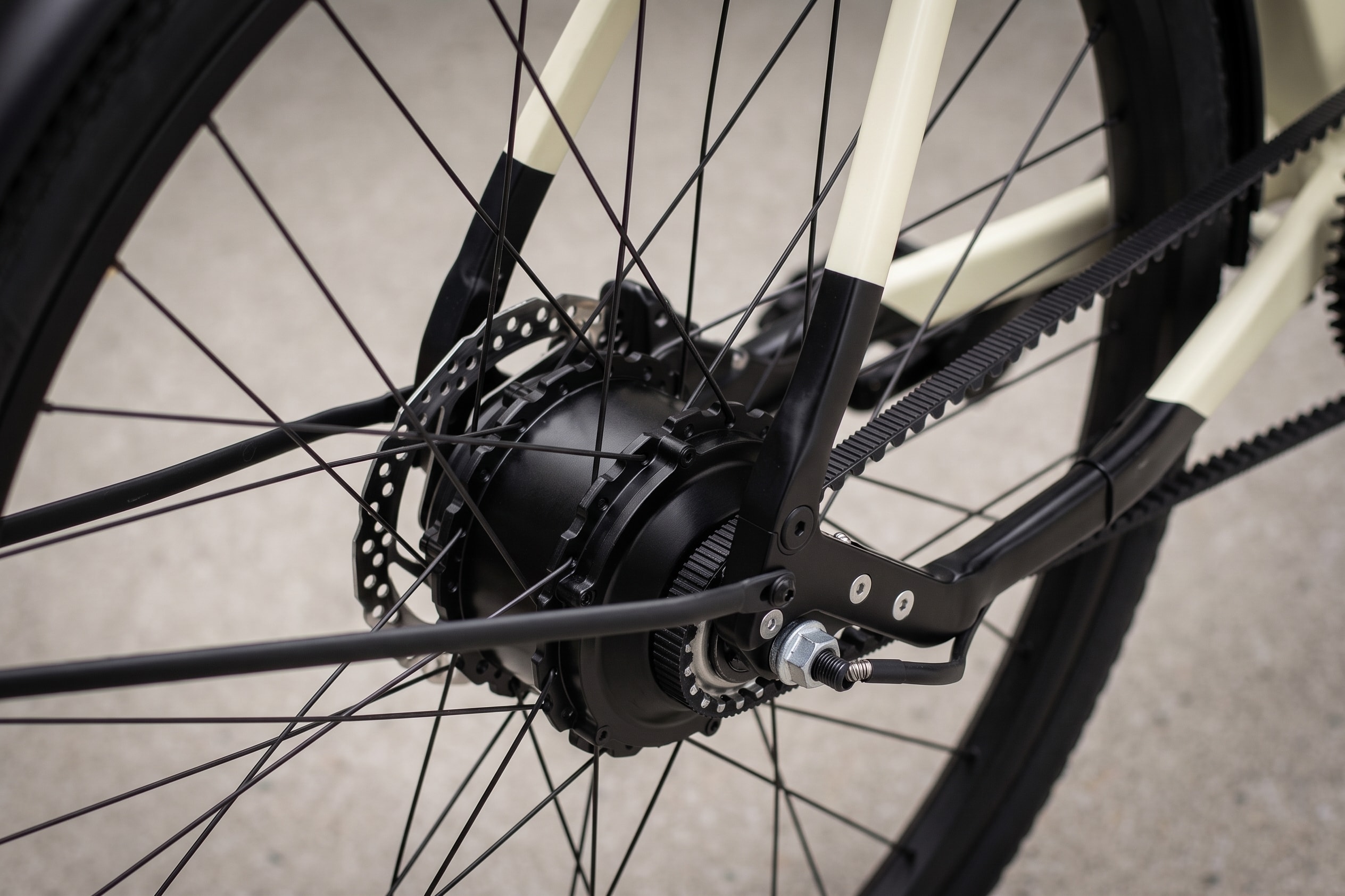
A belt drive replaces the metal chain with a reinforced rubber belt, similar in concept to a timing belt inside a car engine. The belt runs between a front sprocket at the pedals and a rear sprocket at the wheel, transmitting your pedalling force the same way a chain does, but without the need for lubrication or the stretching that comes with metal-on-metal contact.

The belts used on bicycles — most commonly made by Gates or Michelin — are reinforced with carbon fibre or aramid fibres. They’re engineered for a long service life, low noise and consistent tension, and are designed to run dry, meaning no oil, ever.

Because the belt can’t be split and rejoined like a chain, it has to be threaded through a gap in the frame when fitting or replacing it. This is why belt drive bikes always have a frame with a specific opening, usually in the right-side chainstay, that allows the belt to be slipped on and off.
02

Benefits — why people choose belt

What you gain with a belt.

No maintenance.

A chain needs oiling every few hundred kilometres and replacing every 12–18 months of regular use. A belt needs neither. You wipe it down if it gets muddy and that's it. Most riders never think about it between annual services.

Long lifespan.

Gates rates their CDX belt at 30,000 km or more under normal use. A well-maintained chain typically lasts 3,000–5,000 km before it stretches enough to start wearing the sprockets around it. The belt outlasts the chain by a factor of five to ten.

Silent running.

A clean, well-tensioned chain is reasonably quiet. A belt drive is quieter still, with a smooth, consistent sound that doesn't change with wear. On an eBike, where motor noise is already minimal, a belt makes for a genuinely near-silent ride.

No oil, no mess.

Chain oil transfers onto clothing, hands and bags. It attracts grit, turns black, and needs cleaning off regularly to avoid wearing the drivetrain. A belt drive has none of that. Commuters in work clothes notice this most.

Consistent feel.

A new chain feels smooth. An old chain feels slightly rough and skips under load. A belt delivers the same feel at 1 km as it does at 20,000 km, because it doesn't stretch or wear the same way. The ride quality stays consistent over its life.

03

Limitations — what to know before buying

Where chain still wins.

Belt drive is increasingly popular, but it’s still a minority choice. Chain and derailleur is the default because it’s cheaper to produce, works with a wider range of gearing options and is understood by every bike mechanic everywhere. Knowing what you trade away matters.

Gearing is limited.

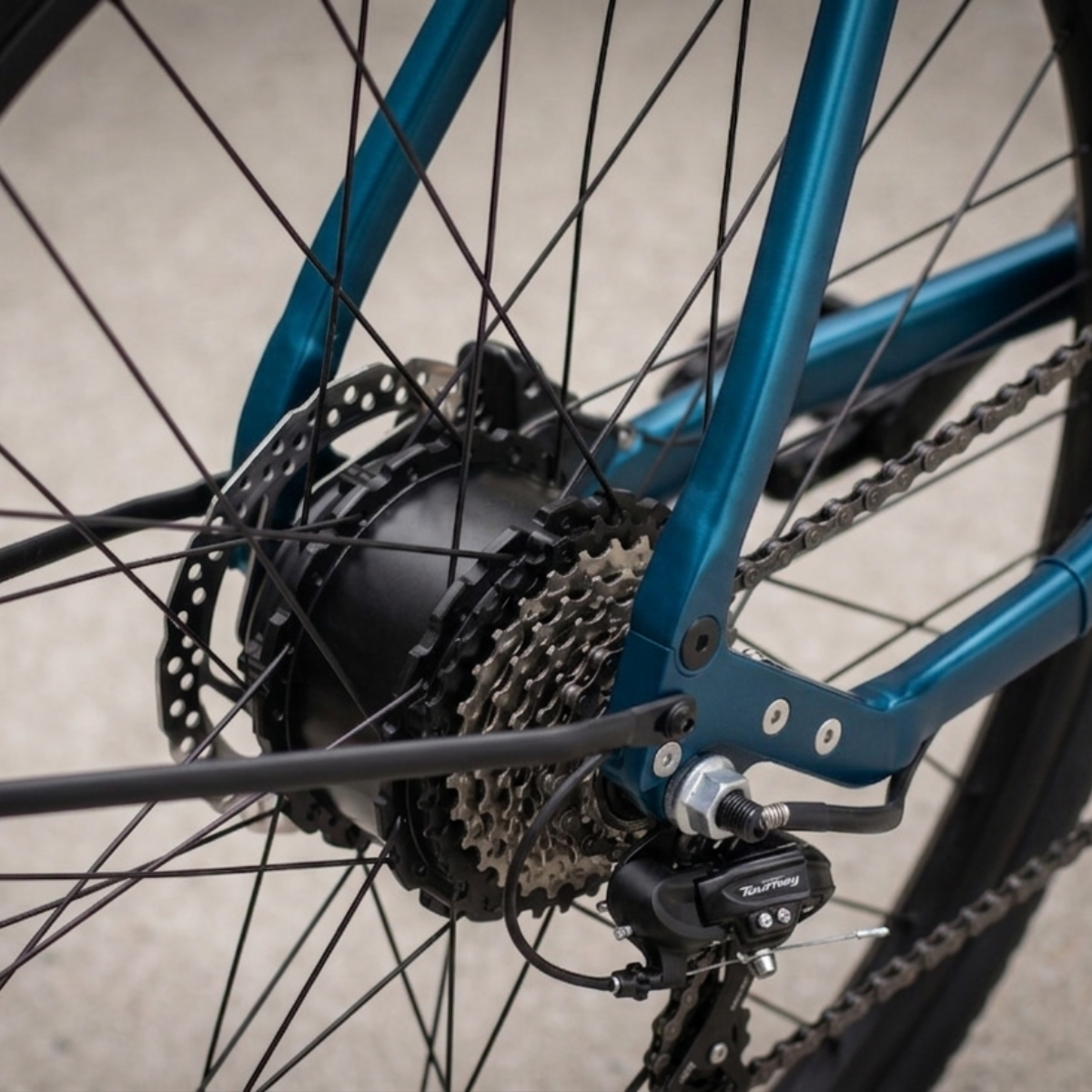
A belt can't run with a standard derailleur, because the derailleur moves the chain sideways to shift between sprockets, and a belt doesn't tolerate the lateral flex. This means belt drive bikes almost always use internal gear hubs, a fixed single gear, or an integrated gearbox. The range of gearing options is narrower than what's available to a chain bike.

It costs more upfront.

A quality belt drivetrain costs more to manufacture than a chain and derailleur of equivalent quality. That cost passes through to the bike's price. The payback comes over time in reduced maintenance, but the sticker is higher.

Not every mechanic knows it.

Belt drive bikes are less common, and not every shop has experience working on them. In practice, there's less to go wrong, so less reason to visit a mechanic, but it's worth knowing that a random local shop may not be set up for it.

Frame compatibility.

You can't retrofit a belt drive to a frame designed for a chain. The frame needs a split in the chainstay for the belt to thread through. If you're buying secondhand or converting, the frame has to be designed for it from the start.

04

Rear wheel — removing it for punctures and maintenance

The question most people don't think to ask.

One consideration that often gets overlooked is how easy it is to remove the rear wheel if you get a puncture or need to do other maintenance. This varies quite a bit depending on how the bike is designed.

Some older belt drive bikes can be tricky. It depends on the design of the dropout, the type of hub motor if there is one, and whether the internal gear hub requires specific handling. A poor dropout design can mean wrestling with the belt and the axle at the same time, which isn’t something you want to be doing on the side of a bike path.

Automatic belt drive eBikes can actually be straightforward to work with here, because there are no gear cables or external derailleur connections to contend with. Once you understand the belt’s threading path through the frame, removal is clean. The more complex the drivetrain around the belt, the more steps are involved.

Before buying any belt drive bike, it’s worth checking the rear dropout design and looking for owner reviews that specifically mention puncture repair or wheel removal. A bike that’s easy to service at the roadside is a better daily companion than one that needs a workshop.

05

The comparison — belt vs chain derailleur

Head to head, honestly.

Both drivetrains work. The right one depends on how you ride and what you value.

Chain & derailleur

More common, cheaper, more flexible.

Works with almost any gearing setup. Parts available anywhere. Cheaper to buy and cheap to replace when worn. Needs regular oiling and periodic chain replacement. Exposed to weather and grime.

Belt drive

Lower maintenance, longer lasting, cleaner.

No oil, no mess, near-silent running. Lasts significantly longer than a chain. Gearing options are more limited. Costs more upfront. Not compatible with standard derailleurs.

The honest summary: for a daily commuter who wants to ride without thinking about the drivetrain, belt wins on maintenance and longevity. For a rider who wants maximum gearing flexibility, buys parts from any shop, and doesn’t mind the upkeep, chain is fine and costs less to get started.

Belt drive
Chain & derailleur
06

Who it suits — and who it doesn't

The right drivetrain for your ride.

Daily commuters.

This is where belt drive earns its keep most clearly. Regular riders notice maintenance requirements more than weekend riders, and a belt removes most of them. Arriving at work without oil on your trousers is a genuine quality-of-life improvement.

eBike riders.

The higher torque output of an electric motor accelerates chain wear more than pedalling alone does. Belt drive is a natural fit for eBikes because the belt handles motor torque better, lasts longer, and doesn't need oiling even under daily electric-assisted use.

Riders who want low hassle.

Some people enjoy maintaining their bike. Many don't. Belt drive is a decision made upfront that pays off quietly over years of ownership with fewer visits to a mechanic and fewer things to do between rides.

For off-road riders and serious mountain bikers who need a wide gear range, there are very few options that pair with a belt drive, with Pinion gearboxes being the notable exception. And for anyone buying on a tight budget, wanting something for short-term or infrequent use, or wanting a bike they can get spare parts for in any shop, chain is still the more practical starting point.

Pinion gearbox with belt drive — one of the few setups that brings belt drive to serious off-road and touring use
07

Gearing — what belt drive is compatible with

Gearing without a derailleur.

Because a belt drive can’t run with a standard derailleur, belt drive bikes have to use a different approach to gearing. There are three main options.

Single speed.

The simplest setup. One gear, no shifting mechanism. Works well in flat terrain, and keeps the bike as simple as it can be. Not practical for hilly cities.

Internal gear hub (IGH).

A sealed gear system built into the rear wheel hub. The shifting mechanism is inside the hub, protected from weather and grime, with gears changed either manually by the rider or automatically by the hub itself. Most commuter belt drive bikes use this. Popular hub systems include Enviolo, Shimano Nexus and Alfine, and Rohloff for more demanding use. Ananda's R900 integrates the gearing into the motor unit itself.

Pinion gearbox.

A gearbox mounted at the bottom bracket rather than in the wheel. Used primarily on adventure and touring bikes where a wide gear range is needed. Expensive, but capable, and a popular pairing for belt drive on serious touring setups.

For eBike commuters, an internal gear hub or integrated automatic gearbox-motor is the most practical pairing. It keeps the maintenance requirements consistent with the rest of the drivetrain: minimal.

08

Cost — upfront and over time

More expensive to start, cheaper to own.

Belt drive bikes cost more to buy. The drivetrain components are more expensive to manufacture, and that’s reflected in the retail price. A belt drive eBike typically starts around $3,500–$4,000 for a quality setup.

The ongoing cost picture is different. Chain replacement runs $20–50 plus labour every 12–18 months for a regular commuter. Factor in cable adjustments, occasional sprocket replacement and general drivetrain servicing, and a chain-drive bike costs meaningfully more to maintain over three to five years of daily use. A belt drive bike’s annual maintenance is a fraction of that, because the belt and the sealed hub need very little intervention.

The payback period depends on how much you ride. For a daily commuter putting 50–100 km on the bike per week, the difference in running costs is real and accumulates fast.

09

The market — belt drive in Australia

Still a minority, but growing.

Belt drive remains a relatively small share of the Australian bike market. Most bikes sold here, electric or otherwise, use a chain and derailleur. That’s changing gradually, led by commuter eBikes where the maintenance argument is strongest, but chain is still the default, and belt drive options require more deliberate searching.

The brands offering belt drive in Australia are mostly European in origin, either sold here through distributors or bought direct. A small number of direct-to-consumer brands also offer it, which tends to bring the price down meaningfully.

Want to explore this further? Check out this Auren guide. Understanding the eBike Market in Australia
10

The bikes — what's available now

Belt drive bikes available in Australia.

This list covers a range of belt drive bikes currently available to Australian buyers, electric and non-electric. Auren is listed alongside competitors in the same way — same format, same information.

11

Frequently asked questions

Common questions answered.

How long does a belt drive last?

Gates rates their CDX belt at 30,000 km under normal use. Michelin’s carbon belts are rated similarly. In practice, most commuters will never replace a belt in the life of the bike. A chain, by comparison, typically needs replacing every 3,000–5,000 km.

Does a belt drive need any maintenance?

No lubrication, ever. Wipe it down if it picks up mud or grit. Tension should be checked occasionally, typically at an annual service. Beyond that, a belt drive is genuinely maintenance-free in the way a chain isn’t.

Can I use a belt drive with normal gears?

No. Belt drive isn’t compatible with standard derailleurs. Belt drive bikes use either a single speed, an internal gear hub, or a gearbox, all of which keep the belt running in a straight line without lateral movement.

Can a belt drive snap?

Yes, but it’s rare under normal use. A belt can be damaged by debris getting jammed between the belt and sprocket, or by running it over a sharp object. A broken belt leaves you without drive, the same as a broken chain. The difference is that chains break more often and more predictably with wear, while a belt tends to last until it’s damaged by an external event.

Is belt drive worth it for an eBike?

For a daily commuter, yes. An electric motor accelerates chain wear because of the higher torque loads, which means chain maintenance is more frequent on an eBike than on a regular bike. A belt removes that problem entirely and keeps the drivetrain consistent and clean regardless of how many kilometres you put on.

The belt drive eBike

No oil. No chain. No thinking about it.

The Auren EV5 pairs a Michelin carbon belt with automatic gearing and a sealed drivetrain. The result is a bike that costs $4,400 direct and asks almost nothing of you between annual services.

Michelin Carbon Belt · Automatic Gearing · $4,400 Direct

0