Guide contents
All titanium guides

How to find the right gravel bike for you

One bike for mixed surfaces, long days and potentially an extended adventure.

A gravel bike is the closest thing cycling has to a do-everything machine — quick enough to enjoy on the road, capable enough to leave it. But “gravel” stretches from stripped-back race bikes to loaded expedition rigs, and the right one depends entirely on the surfaces you ride and the days you have in mind.

This guide walks through it: what a gravel bike actually is, how to spec one for racing, group rides or bikepacking, how tyres and geometry trade speed for comfort, and what the market looks like from a first alloy bike to a custom titanium frame built around you.

Your ideal setup for a gravel bike

Built your way, for where you ride.

There’s no one-size-fits-all gravel bike. Every choice is a trade-off on a spectrum, and the right point on it comes down to your terrain, your riding style and your body. This is where you decide what works for you.

Head angle. Slacker is calmer on loose descents; steeper steers quicker. Set for your terrain.

Geometry.

Tailored to you, for maximum comfort and efficiency. Tap the dots to see what gets tuned, then flip the frame between its two characters.

WHEELBASE
Shorter
HEAD ANGLE
Steeper
STACK
Lower

Loaded changes everything. Twelve kilos of bags changes how a bike handles. A frame designed for the loaded case stays stable where an off-the-shelf race frame gets nervous.

Your numbers come from a bike fit (best), your current bike, or your measurements.

700×40 700×50 29×2.6
Fast & smoothRough & loaded
Fast gravel and hardpack, big days at speed.

Tyre clearance.

From 700×40 to 27.5/29×2.6. The frame is built around the rubber your riding wants.

Rolling speed
Capability & comfort

Counterintuitive but true: on rough ground, the bigger tyre is often the quicker one.

Two bikes in one frame. Generous clearance means the same bike runs 700c for speed and 650b with fat rubber for adventure.

CABLE UNDER THE TUBE IN AT THE TOP, GUIDED INSIDE INSIDE THE WHOLE WAY
Field serviceableShowroom clean

Cable routing.

Three ways to run the cables through the same frame, from easiest to fix on a fire trail, to the cleanest possible lines.

External. Fixable on a remote fire trail with what's in your pack. The expedition choice.

Common gravel configurations
1× GRAVEL
Tube-in-tube
Di2/AXS
Fully hidden
EXPEDITION
External

Forks.

Fork choice affects speed, comfort, durability and terrain capability.

Carbon
Lightness
Rough terrain
Carrying
Race & all-road
Suspension
Lightness
Rough terrain
Carrying
Rough terrain & comfort
Titanium
Lightness
Rough terrain
Carrying
For life & loaded
Carbon
Titanium
Suspension
Smooth hardpackChunky singletrack
A quick loop: two bidons, nothing else welded on.

Mounting points.

Match the mounts to your adventure.

Bidon cages
Top-tube bag
Custom frame bag
Seat pack
Fork anything-cages
Rear rack

You get the mounts your riding needs, and a clean frame everywhere else. And because the geometry is yours, a custom frame bag fills the entire main triangle, no wasted litres.

TitaniumBest fit
SteelStrong alternative
CarbonAlso good
Comfort and durability over outright grams — the gravel priority.

Materials.

Mixed surfaces, long days, washboard fire trails and broken bitumen. Comfort over a full day matters as much as outright speed, and the frame needs to absorb a beating without wearing the rider out.

Best fit: titanium. The natural compliance soaks up rough surfaces, it takes racks and mounts for bikepacking, and it lasts for decades. Comfort, durability and weight all land where gravel needs them.

Strong alternative: steel. The supple, “alive” ride feel is superb on gravel, it’s tough and repairable in the field, and quality tubing keeps it competitive. The penalty is weight on long climbs.

Also good: carbon. With tuned compliance and clearance it’s light and fast, but the impact risk on rocky, remote terrain is a real consideration.

Everything else.

Every other part and frame spec can be tailored to your ride and your budget.

Bottom bracket
Headset
Dropouts
Brake mounts
Seatpost
Finishing
Finishes
Raw brushedthe classic
Sandblastedlogos & graphics
Engravedheadtube logo
Paintedany colour
Anodisedcolour splash

You don't need to know any of this before calling. Will walks you through every decision with a recommendation and a reason.

01

What is a gravel bike?

A bike built to leave the tarmac.

A gravel bike is a bike with wide tyre clearance, stable-but-quick handling and mounting points for luggage — built to be one bike across many surfaces rather than a specialist for any single one. It’s the generalist, where a road bike is the specialist. Previously gravel bikes were mostly drop-bar, but increasingly various flat-bar options are becoming popular.

A road bike does one thing exceptionally well and little else. A gravel bike gives up a small slice of outright road speed and gains off-road capability, load-carrying and all-day comfort in return. Fit a second wheelset with slick tyres and it comes within a kilometre or two an hour of a road bike on pavement — while still going everywhere a road bike can’t.

Two things physically separate it from a road bike: tyre clearance (typically 40–50mm, and sometimes full MTB tyres) against a road bike’s 28–34mm ceiling, and mounting points on the frame, fork and top tube for bags, racks and bottles. It also runs lower gears and a slightly more upright position — the trade for control and comfort over a long day. Where it sits on the spectrum from fast-and-light to rough-and-loaded is the decision the rest of this guide is about.

02

Use cases — how you ride should shape the bike you choose

Three ways to ride gravel.

A gravel frame can be tuned anywhere along one spectrum: fast-and-light at one end, rough-and-loaded at the other. Most riders sit at one of three points on it, and the spec follows from there.

Racing and fast gravel

Gravel racing is booming, and Australia hosts the 2026 UCI Gravel World Championships in Nannup, WA this October — alongside a record national calendar. A race build is specced for speed: lower, racier geometry with a shorter wheelbase and steeper head angle for sharp, quick handling; faster-rolling tyres at the narrower end of the range (around 40mm) for hardpack; and speed-focused gearing — a 2× for fine cadence steps and a higher top end, or a 1× for simplicity. Everything else is stripped back: minimal mounts, two bottles, nothing extra welded on. The trade-off is that a race bike gets twitchy under load and harsher over a long day. Aero matters less than on the road — you can’t make a knobbly tyre slippery — so tyre choice and pressure are the real speed levers.

Group rides and social gravel

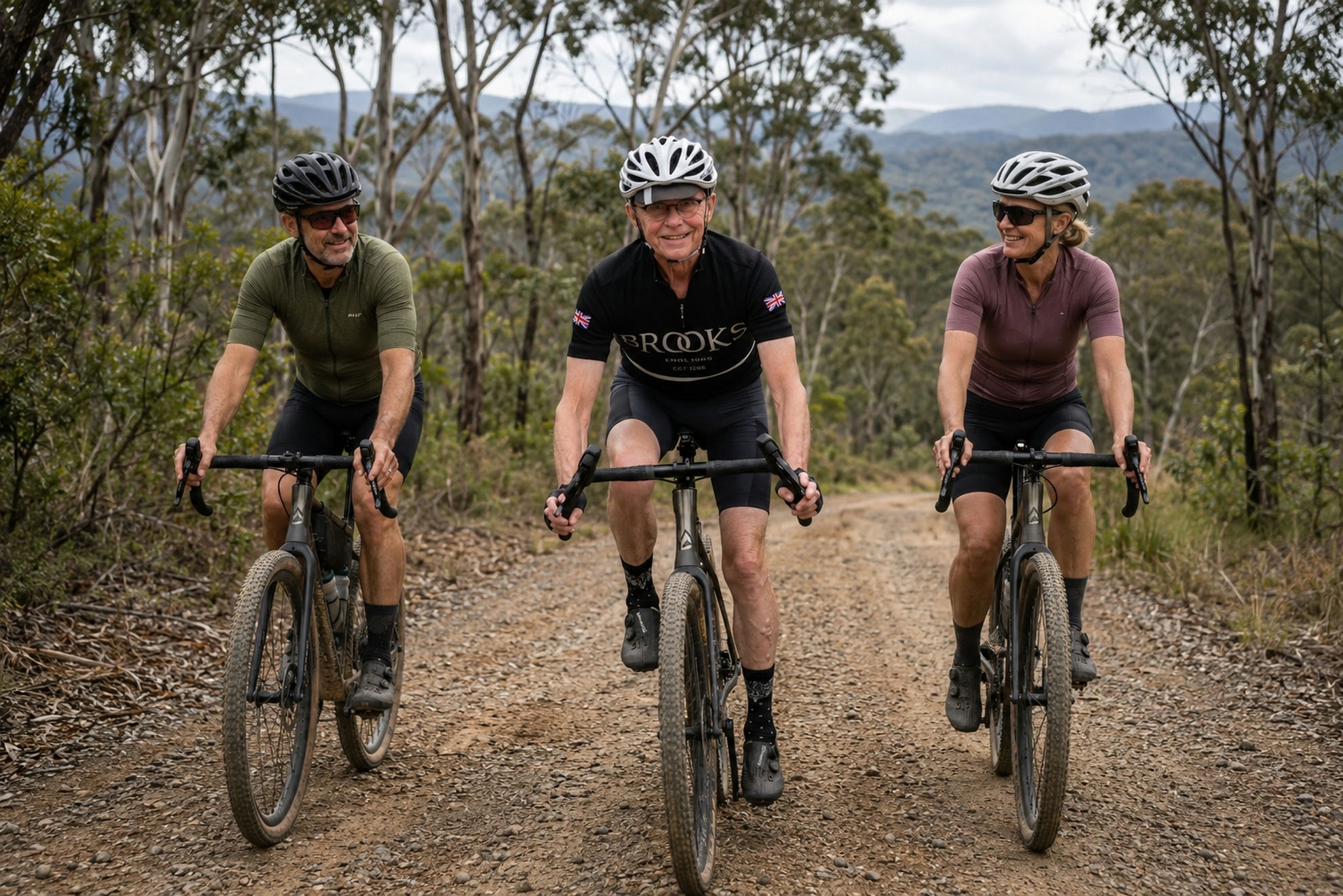
The all-rounder, and where most riders sit most of the time. The geometry is the balanced middle: stable and comfortable enough for hours in the saddle, quick enough to hold a bunch. Tyres land on the 45mm “do-everything” width — plush on chunky gravel, fast enough for the tarmac that links it, which is exactly what most modern gravel bikes are designed around. A wide-range 1× (a 40T chainring with a 10–44T cassette) covers most climbs and descents with one shifter to think about. Because these rides are long, fit and frame compliance matter more than outright speed — which is where titanium’s ride quality earns its place. Mounts are enough for a day out: bottles and a top-tube bag, without the full rack. Some frames are designed to allow a swap between 700c wheels for speed and 650b/27.5″ for adventure. Two bikes in one frame.

Group rides and social gravel scene
Bikepacking and loaded touring

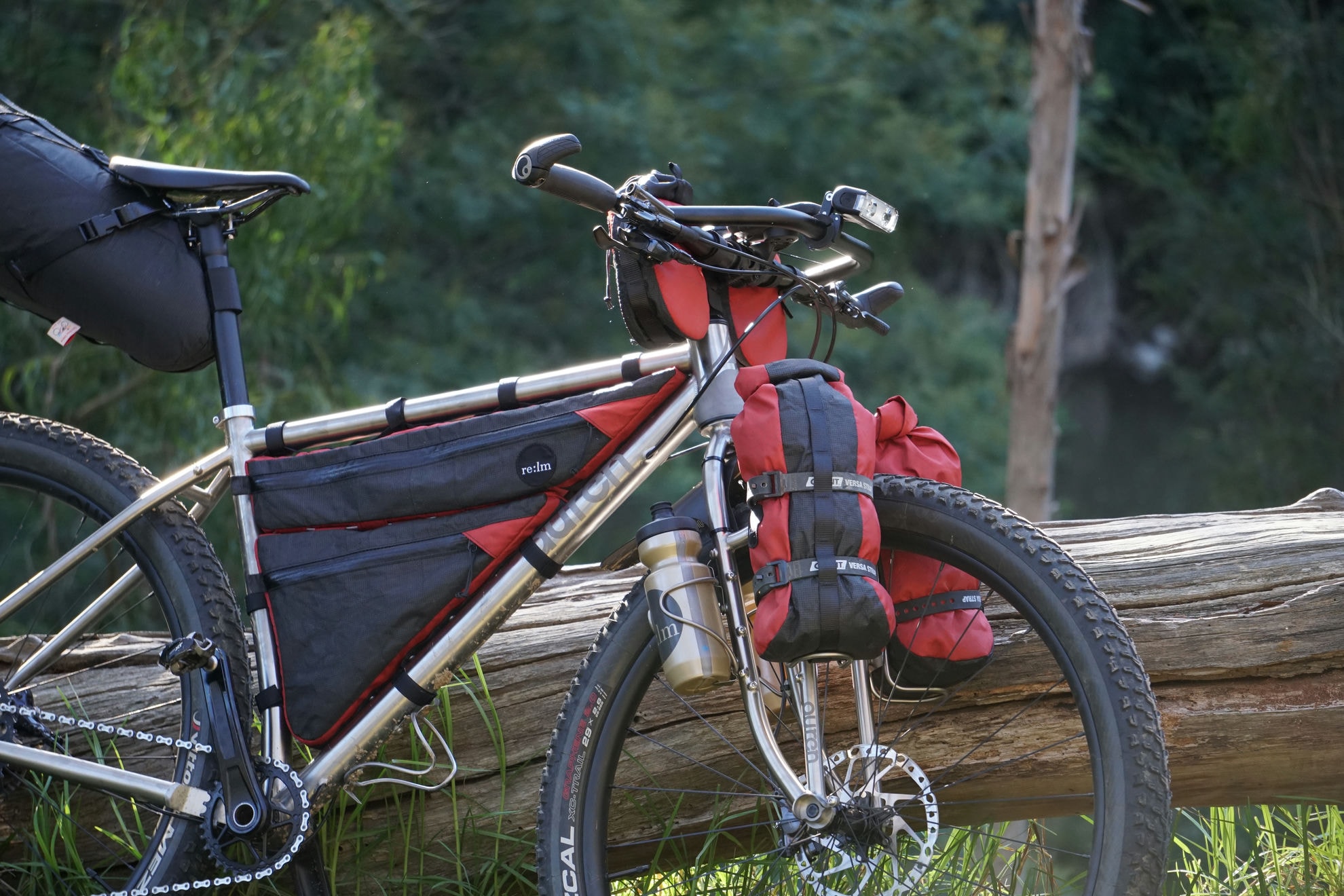
A loaded bike is a different bike. Twelve kilos of bags changes how it handles, and a frame designed for the loaded case stays calm and planted where a race frame gets nervous. The build goes long and stable: a longer wheelbase and more relaxed angles for composure under load and on loaded descents, and longer chainstays that add stability and make room for a frame bag. Tyres run wide — 50mm to 2.6″ — for air volume, comfort and float on rough or sandy ground; counterintuitively, on rough terrain the bigger tyre is often the faster one. Gearing goes to its lowest, widest range, with a smaller chainring to keep your legs turning when the gradient bites under a full load. The custom-only advantage: because the geometry is yours, a custom frame bag fills the entire main triangle with no wasted litres, where off-the-shelf frames leave dead space. Match the mounts to the trip — day ride, gravel event, overnighter, expedition — and centralise the mass: heavy items low and near the bottom bracket, lighter bulky gear in seat and bar bags. This is also where a Pinion gearbox can shine, for a low-maintenance and durable alternative to a conventional derailleur-based drivetrain.

Bikepacking and loaded touring gravel bike
Want to explore this further? Check out this Auren guide. The Ultimate Pinion Gearbox Guide
03

The rider experience — speed versus comfort

On gravel, smooth is fast.

When it comes to choosing the tyre width for your application, smooth is fast (up to a point). Wider tyres at lower pressure conform to the surface, which reduces rolling resistance on rough ground while massively improving comfort. Past a point, comfort and speed on gravel stop being opposites — they can be conducive to each other.

Tyres are the single biggest factor affecting ride feel. Going from 38mm to 47mm changes the ride more than swapping the frame would. Narrower and harder is faster on hardpack; wider and softer gives comfort, traction and float on rough ground. Frame material comes in underneath that: titanium’s natural compliance takes the edge off the trail buzz an alloy or carbon rear end transmits, adding comfort without the weight or upkeep of suspension. And comfort is fit as much as material — a frame set to your reach, stack and angles is more efficient, easier on the body over years, and more comfortable on the long days gravel is all about.

SetupTyresPosition / geometryBest for
Fast / race ~40mm, fast tread Lower, racier, short wheelbase Hardpack, events, speed
All-round ~45mm Balanced middle The do-everything; most riders
Rough / loaded 50mm+ (or 650b) Relaxed, long wheelbase Loaded, technical, remote
What to look for

Before you weigh up frames, weigh up tyres. Tyre width and pressure shape how a gravel bike rides more than any other single choice. Pick the width for your usual surface first; the frame is built to clear it.

04

Understanding the market

From a first alloy bike to a forever frame.

Almost the whole gravel market is one of two things: off-the-shelf, with preset models, a couple of size and wheel options and fixed geometry; or fully custom, bespoke options made to order.

TierPrice (AUD approx.)MaterialWhat you get
Entry / value $1,200–$2,500 Aluminium First gravel bike, capable alloy, mechanical groupset
Mid $2,500–$5,000 Alloy / Steel / entry carbon Better groupset and wheels, tubeless-ready
Premium production $5,000–$12,000 Carbon Top components, race or adventure carbon
Custom $7,000–$30,000 Titanium / Steel Bespoke geometry, a forever frame
05

Get a gravel bike built around you

The right gravel bike is the one built around how you actually ride.

Geometry, tyre clearance, gearing range, mounts and frame-bag fit are one decision on a custom titanium frame — not a set of compromises inherited from a size chart. Will talks every build through one-on-one — the surfaces you ride, the loads you carry, the days you have in mind — and designs the frame around your point on the spectrum from the first sketch.

06

Frequently asked

Gravel questions, answered.

What is a gravel bike?

A drop-bar bike with wide tyre clearance, stable-but-quick handling and mounting points for luggage — built to handle many surfaces rather than specialise in one. It trades a little road speed for off-road capability, comfort and the ability to carry gear.

What's the difference between a gravel bike and a road bike?

Two things, mainly: tyre clearance and mounts. A gravel bike clears 40–50mm+ tyres against a road bike’s 28–34mm, and has bosses for bags and racks. It also runs lower gears and a slightly more upright position. The trade is a small amount of outright road speed for far more versatility.

What size tyres should a gravel bike run?

It depends on the surface. Around 40mm is fast on hardpack and suits racing; 45mm is the do-everything middle most riders want; 50mm and up gives comfort and float on rough or loaded rides. Tyre width and pressure shape the ride more than any other single choice, so pick for your usual terrain first.

Is a gravel bike good for commuting?

Yes — it’s one of the most versatile commuters going. Fit faster tyres and it’s quick on tarmac; the mounts take racks and mudguards; and the comfort suits longer or mixed-surface trips. If your commute includes any rough sections or you want one bike for work and weekends, it’s a strong choice.

What's the best gravel bike for bikepacking?

One built for the loaded case: a longer, more relaxed frame that stays stable under bags, wide tyres for float and comfort, low gearing for loaded climbs, and a full set of mounts. On a custom frame the bag fits the exact triangle with no wasted space — a real advantage over off-the-shelf frames that leave dead litres.

Chosen with you

The right gravel bike is the one built around how you actually ride.

There is no single best gravel bike — only the best one for your surfaces, your loads and the days you have in mind. On a custom titanium build the geometry, tyre clearance, gearing and mounts are specced into the frame from the start, and Will talks every build through one-on-one so the bike sits exactly where you ride.

Custom titanium · Built for mixed surfaces · Designed one-on-one with Will

0