Guide contents
All titanium guides

How to get your right mountain hardtail bike

One front fork, no rear shock, and a world of riding.

The adventure hardtail is the most versatile bike in mountain biking — simple enough to take days into the wilderness, capable enough to ride proper trails when you get there. But “hardtail” covers everything from featherweight XC racers to slack, hard-charging trail machines, and the right one depends entirely on how and where you ride.

This guide walks through it: how to build or find the bike that fits you, why adventure riders choose a hardtail in the first place, how travel and geometry change the way it rides.

Find your ideal setup for a hardtail adventure bike

Breaking down the elements of your bike.

Let’s begin by exploring the key parameters to consider when buying or customising your ideal mountain hardtail bike.

SteelBest overall
TitaniumBest overall
AluminiumFor value
CarbonFor racing
Durability and repairability over grams — the hardtail priority.

Materials.

The most adventure-focused archetype — train out of the city, ride proper trails, technical singletrack, rougher terrain than the gravel rider seeks. Durability over weight is the priority: a frame that takes hits without giving up.

Best overall: Steel or titanium. Both prize toughness and repairability over grams. Steel shrugs off impacts and can be repaired almost anywhere; titanium adds no-rust, no-fatigue longevity for a frame that lives hard for decades. For a hardtail that gets genuinely abused, these are the confidence picks.

For value: Aluminium. Crash-tolerant and affordable — a sensible choice if the frame is treated as replaceable rather than a forever bike.

For racing: Carbon Fibre. Light and capable, but a hidden crack from a rock strike on a remote trail is the exact failure mode you don’t want far from help.

Head angle. Steeper steers quick for XC; slacker brings confidence on steep descents.

Geometry.

Tailored to your fit and application. Tap the dots, then flip the frame between its two characters.

HEAD ANGLE
Steeper
REACH
Shorter
CHAINSTAYS
Tighter

The frame is designed for its fork — geometry and travel are one decision, not two.

A 120mm and a 140mm fork need different frame geometry to end up at the same intended ride. Will designs them together, which off-the-shelf S/M/L frames never do. Your numbers come from a bike fit, your current bike, or measurements.

2.2" 2.5" 2.8"
XC speedTraction & float
XC speed — light, quick, efficient.

Tyre clearance.

Anywhere from 27.5/29 × 2.2 to 2.8", depending on how and where you like to ride. All knobbies here — the spectrum is tread volume and footprint.

Rolling speed
Traction & float
Wheel size

29". Momentum and roll-over — it carries speed through the rough.

No rear shock. Doesn't need one — titanium compliance plus 2.6 inches of air is suspension you never service.

DROPPER LINE CABLE UNDER THE TUBE THROUGH THE HEADSET
Trailside serviceableSnag-free minimal

Cable routing.

Fully external for ease of build and servicing and a traditional look, or internal through the headset for a minimal, snag-free front end.

External. A crimped housing fixed in the carpark, not the workshop. Nothing hidden, everything reachable.

Common hardtail configurations
REMOTE RIDER
External
CLEAN BUILD
Through-headset
EITHER WAY
Dropper internal

The dropper post routes internally in both options, planned from the start — the cable other brands' diagrams forget.

100mm OF TRAVEL
Smooth singletrackRock garden
XC race — efficiency first, every gram counted.

Forks.

A range of options from Fox, RockShox and more, with 100–140mm travel. Travel is the headline decision of this build.

Fox RockShox + more

More travel isn't more better. It's matched to your trails — that's the custom part.

Travel changes the frame. Pick travel first; the frame is designed around it. Up-forking an off-the-shelf hardtail ruins the geometry — on an Auren, it is the geometry. More travel than your trails need just costs weight and pedalling efficiency.

1 2 3 4
1 Bidons in the triangle 2 Anything cages 3 Rack mounts 4 Dropper-ready 31.6
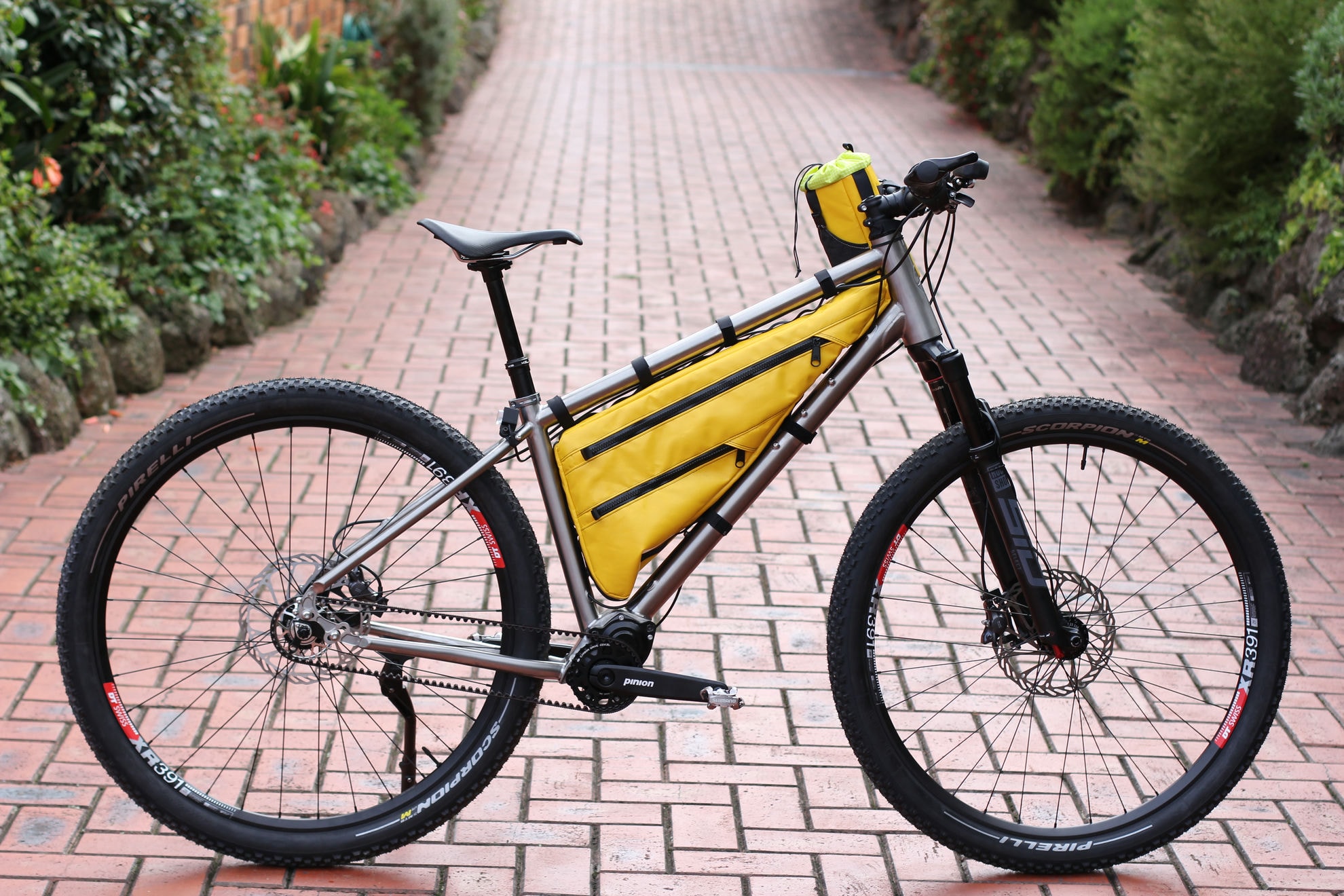
Roomy front triangle — space for a full frame bag.

Frame style & mounts.

Optional gussets, rack, bag and bidon mounts, frame compactness profiles and more.

Gussets
Compactness

Gussets in one breath: reinforcing plates at the head tube junction for riders and terrain that hit hardest. Added for the jump-line and rock-garden crowd, left off for the XC build. More slope means more standover and a longer dropper; less slope means a roomier triangle for a frame bag that fills it completely.

Gussets where you ride hard. Clean tubes where you don't. Strength is a spec, not a default.

Everything else.

Every other part and frame spec can be tailored to your ride and your budget.

Bottom bracket
Headset
Boost dropouts
Post-mount brakes
Dropper seatpost
Finishing
Finishes
Raw brushedthe classic
Sandblastedlogos & graphics
Engravedheadtube logo
Paintedany colour
Anodisedcolour splash

You don't need to know any of this before calling. Will walks you through every decision with a recommendation and a reason.

01

What is a hardtail?

A suspension fork up front, a rigid rear.

A hardtail has a suspension fork up front and a rigid rear end — no rear shock. Before we get into the three main categories of hardtails, a quick note on the rising use of hardtails for rugged adventure bikepacking:

02

Why riders choose a hardtail for adventure

Four reasons it wins out there.

Efficiency and weight

With no rear shock to compress, the rigid rear triangle transfers power straight to the wheel — no pedal bob, no energy lost compressing a shock. A hardtail weighs around 1.5 kg (about 3.3 lb) less than a comparable full-suspension bike, simply because it has fewer parts: no rear shock, bushings, bearings or linkages, yet the bike is much more capable and comfortable than a fully rigid bike.

Fewer things to go wrong — the adventure clincher

This is the argument that wins for remote riding. Compared to a full suspension, a hardtail has fewer moving parts to maintain and repair on a long trip — exactly what you want when you’re days from a bike shop. For the long-distance crew, it means more places to attach bikepacking bags and bottles, and less to go wrong in the wilderness.

Cargo capacity

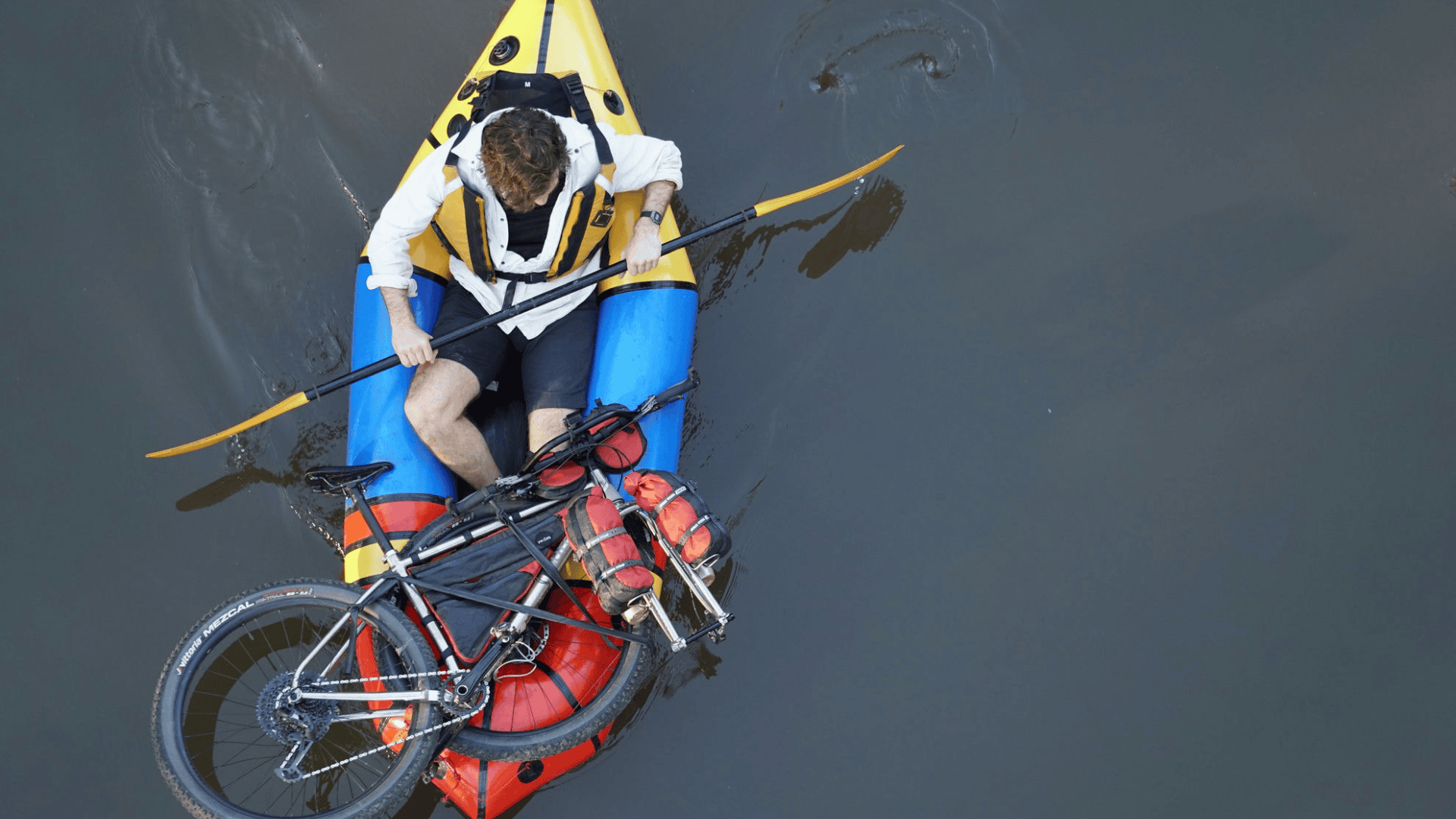
The open front triangle is a practical advantage. Full-suspension bikes aren’t built for luggage — at best you squeeze a small bag in around the shock and linkage. Hardtails typically have room for a full frame bag plus multiple bottle and rack mounts.

Cargo capacity shot for adventure hardtail
Cost and skill

Hardtails are usually cheaper, and they make you a better rider. They give honest feedback from the trail — a bad line or an unabsorbed bump is something you’ll feel, which builds proper technique over time.

The honest counterpoint

A hardtail is less cushy and takes more skill on really technical trails. The adventure rider chooses it knowing that trade-off — prioritising reliability, range and simplicity over outright descending comfort.

Two bikes in one. Most hardtails can be converted to fully rigid by swapping the suspension fork for a suspension-corrected rigid fork — giving a lighter, simpler bike ideal for smoother dirt and remote trips where simplicity is everything. That flexibility suits a custom titanium frame especially well, since the frame can be designed to ride well in both forms.

Want to explore this further? Check out this Auren guide. The Ultimate Guide to Bike Forks
03

Types of hardtail: how travel and geometry vary

From light XC race to near-enduro.

Hardtails sit on a spectrum from gravel-adjacent race bikes to near-enduro machines. Two dials define where a given bike lands: fork travel (how much the front absorbs) and head tube angle (steeper = sharper steering and better climbing; slacker = more stable and confident descending). As a rule, travel increases as the bike's intentions get more aggressive, and the head angle is the single most important geometry number — a steeper, higher number gives quick, responsive steering for climbing; a slacker, lower number gives stability at speed and on steep descents. Three categories cover the field:

Cross-Country (XC) — the lightest, fastest-climbing end

Fork travel typically 90–120mm, steeper head angles around 67–69°, shorter chainstays (425–435mm) for agility, and low weight around 10.5–12.5 kg. Built for climbing efficiency and pedalling response. Best for smooth singletrack, fire roads, marathon distance and racing — 100–120mm is just enough to take the edge off and keep traction without compromising the climbing position.

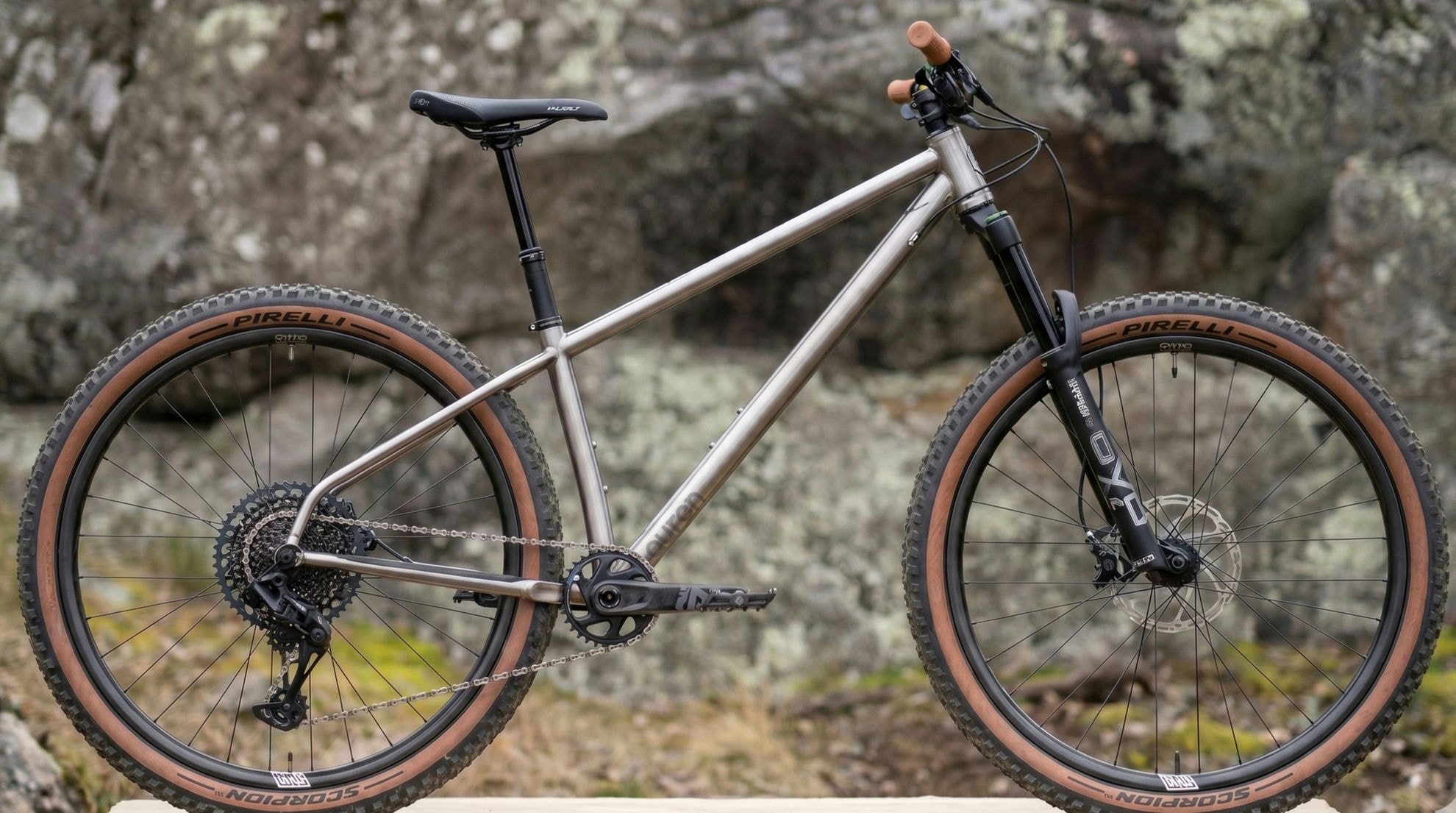
Auren Cross Country
Auren Cross Country
Trail — the versatile middle, and the adventure sweet spot

130–150mm of travel is the sweet spot for versatility — enough to handle significant drops and rock gardens with confidence, making the bike far more capable and fun when the trail points down. Head angles sit slacker than XC. This is the do-everything adventure hardtail, and where most adventure riders land.

Auren Trail
Auren Trail
Aggressive / Enduro (“the hardcore hardtail”) — slack, long, capable

Designed on average around a 140mm fork (with outliers like the Chromag Rootdown running up to 170mm), paired with slack head angles. The Marin El Roy — the “enduro of hardtails” — runs a 64° head tube angle with long reach and short chainstays. Built for technical, steep, rough terrain where a rider wants full-suspension-like confidence on the descents but the simplicity and feedback of a hardtail.

Auren Aggressive
Auren Aggressive

Context worth knowing: modern hardtail geometry has shifted hard toward “longer, lower, slacker.” Models like the Specialized Chisel and Nukeproof Scout now run 64–65° head angles versus 67–68° back in 2019, with longer reach and 435–450mm chainstays for balance and climbing. Today’s hardtails are far more capable than the category’s old XC-only reputation.

TypeFork travelHead angleBest for
XC 90–120mm ~67–69° (steeper) Climbing, smooth singletrack, distance, racing
Trail 130–150mm ~65–66° All-round adventure; the versatile do-it-all
Aggressive / Enduro 140–170mm ~63–65° (slack) Steep, technical, rough descents
One builder's caveat

Don’t over-fork a frame. Increasing fork travel by more than about 20mm radically changes geometry — slackening the head angle, but also raising the bottom bracket and slackening the seat tube, which can ruin climbing ability and stress the head tube. It’s a strong argument for a custom frame designed around the intended travel from the start.

How titanium blurs the line between hardtail and full-suspension

A well-designed titanium hardtail narrows the gap to full-suspension more than any other material. Titanium’s natural compliance takes the edge off trail chatter that would rattle through an alloy or carbon rear end, so a rigid back end rides closer to “softtail” territory — much of the comfort of rear travel, with none of the weight, maintenance or moving parts. Paired with the right tyre volume and a frame tuned for the rider’s terrain, a custom titanium hardtail delivers descending confidence and all-day comfort that belies its simplicity.

04

Understanding the market

From a first $1,000 bike to a forever frame.

The hardtail market in Australia spans an enormous range — from sub-$1,000 entry bikes to $30,000 custom builds. Four tiers are useful for working out where you sit.

Entry / value ($800–$2,000) — the gateway tier

Dominated by alloy 29ers. Reid’s Tract range is a benchmark, starting around $1,000 with a 12-speed groupset, hydraulic brakes and an alloy frame. The standout value bike is Merida’s Big Trail 500 — currently around $2,199 with a 140mm RockShox Psylo fork, Shimano CUES drivetrain, dropper post and progressive trail geometry. This is where most first-time adventure riders enter.

Mid ($2,000–$4,000) — serious recreational riders

Quality alloy and entry carbon, with better forks and drivetrains. Canyon’s carbon XC hardtail sits here — the Exceed CF with Shimano Deore 12-speed and a RockShox Recon Silver, in the low-$3,000s.

Premium production ($4,000–$8,000) — high-end carbon

Top components and race or capable-trail carbon hardtails from the major brands.

Custom / titanium ($7,000–$30,000) — the bespoke tier

There’s a wide spread here: a locally-welded fully-custom titanium bike in Australia typically costs between $18,000 and $30,000, while builders sourcing the frame more efficiently can sit in the $7,000–$16,000 range — custom titanium at closer to off-the-shelf titanium prices.

05

The hardtail built around you

The most capable hardtail is the one built around how you actually ride.

Travel, geometry, tyre clearance, routing and mounts are all one decision on a custom titanium frame, not a set of compromises inherited from an off-the-shelf size chart. Will talks every build through one-on-one — the trails you ride, the loads you carry, the feel you’re after — and designs the frame around the intended fork and terrain from the start.

06

Frequently asked

Hardtail questions, answered.

What is a hardtail mountain bike?

A mountain bike with front suspension but no rear shock — the back end is a rigid frame. That’s the “hard tail.” You get a suspension fork to take the edge off the front, and a simpler, lighter, lower-maintenance rear than a full-suspension bike, at the cost of some cushioning over rough ground.

Is a hardtail good for trail riding?

Yes, and it’s where most riders spend their time. On flowing singletrack and moderate trails a hardtail is fast, direct and rewarding — it teaches good line choice because the rear can’t bail you out. It’s less forgiving than full-suspension on the roughest, rockiest terrain, but for the majority of trail riding it’s more than enough bike.

How much fork travel do I need on a hardtail?

For an adventure hardtail, 100–130mm covers most riding. Around 100mm keeps things light and efficient for XC and long days; 120–130mm adds confidence on descents and technical ground. More than that starts to unbalance a hardtail’s geometry. The right number follows the terrain you ride most, which is a decision worth making before the frame is built around it.

What's the best frame material for a hardtail?

For a do-everything adventure hardtail, titanium and steel lead — both have the natural compliance that matters most when there’s no rear shock to soak up the trail. Titanium adds corrosion resistance and a lighter weight for the same durability. Aluminium is light and affordable but stiffer and harsher, and carbon is light but carries impact risk on rough, remote ground.

Can a hardtail handle technical descents?

Up to a point, and further than most people expect with the right setup. Modern slack geometry, a capable fork and wide tyres let a good hardtail descend confidently on all but the roughest terrain. What it asks of you is more precision — you pick cleaner lines and stay lighter on the bike, because the rear won’t absorb mistakes. On truly rough, high-speed descents, full-suspension pulls ahead.

Chosen with you

The most capable hardtail is the one built around how you actually ride.

There is no single best hardtail — only the best one for your trails, your loads and the way you like to ride. On a custom titanium build the travel, geometry and mounts are specced into the frame from the start, and Will talks every build through one-on-one so the handling is set deliberately, never inherited by accident.

Custom titanium · Built for the trail · Designed one-on-one with Will

0